A challenge designed to turn learning into impact
By Mariah Rawding
November 2026
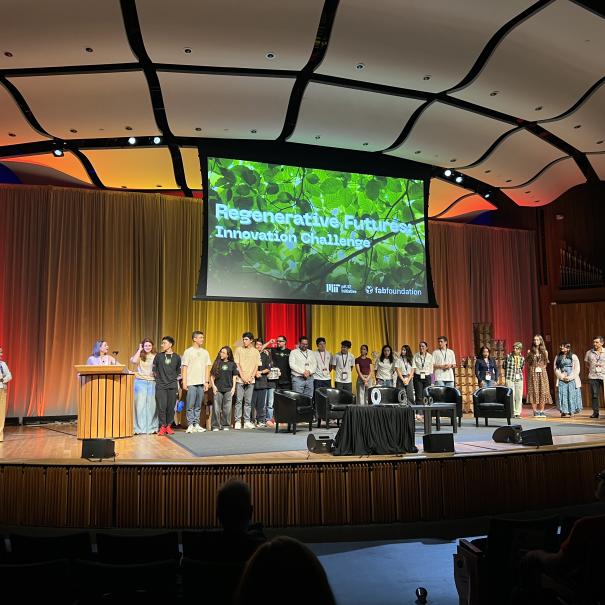
The pK-12 Initiative at MIT and the Fab Foundation created the Regenerative Futures Challenge to inspire young people to develop creative solutions to the world's most pressing environmental issues. It ran alongside pK-12's Day of Climate as a reminder that meaningful learning happens when students turn their knowledge across disciplines into action to address real-world challenges.
Over six months, teams from around the world, each made up of high school students and a mentor, worked on projects for their own communities. Through workshops, mentorship opportunities, community partnerships, and hands-on building, they explored regeneration and circularity as strategies for sustainability in their projects.
“All the teams who participated in this challenge are truly inspiring. The climate crisis is here– it’s happening now, and it’s a systemic issue that’s going to require solutions and commitments from people all over the world,” says Emily Glass, Senior Designer at the pK-12 Initiative.
Building durable solutions takes time, planning, and coordination. Teams were tasked with engaging their communities as co-designers, gathering input on their solutions before their final presentations. By thinking about the future together, they aimed to create solutions that would have lasting impact beyond the challenge.
“It’s incredible, and hopeful for the future, that such sophisticated, thoughtful answers are coming from high school students. This issue means a lot to them, and it shows,” she adds.

Meet the finalists
Learners and mentors from Nigeria, Colombia, Brazil, India, and the United States used their skills to take on real problems. These ranged from plastic waste to flood-prone sewers to failing tidal ecosystems. Through the process, teams refine their solutions based on feedback at every stage, demonstrating the importance of iteration in designing real-life solutions. These projects represent only the beginning of the impact these learners will have in their communities and beyond. To help move these ideas forward, each team received funding from the challenge for an early-stage prototype, which ranged from low-cost solutions to more advanced builds.
These four finalists were the top selected projects by the judges.
Young Innovators for Water Regeneration
Team: Mariana López Orozco, Camilo Arango Restrepo, Miguel Chitiva Buritica, Isabella Zuluaga Arango, Samuel Martelo Ojalvo, María Antonia Cossio Amaya. Mentored by Víctor Hugo Lopera Agudelo
Location: Medellín, Colombia
This team set out to restore La Volcana Stream, one of many city streams in Medellín that are losing their natural ability to clean and balance themselves. Their prototype is a station that both monitors and helps heal the stream. A PVC chamber sits in the water, and the stream flows through plants such as duckweed, water hyacinth, and vetiver that help filter pollutants. Sensors track pH, cloudiness, conductivity, temperature, and water level. A solar-powered sculpture glows green, yellow, or red, so neighbors can read the stream’s health at a glance, and problems can be caught before they become visible.
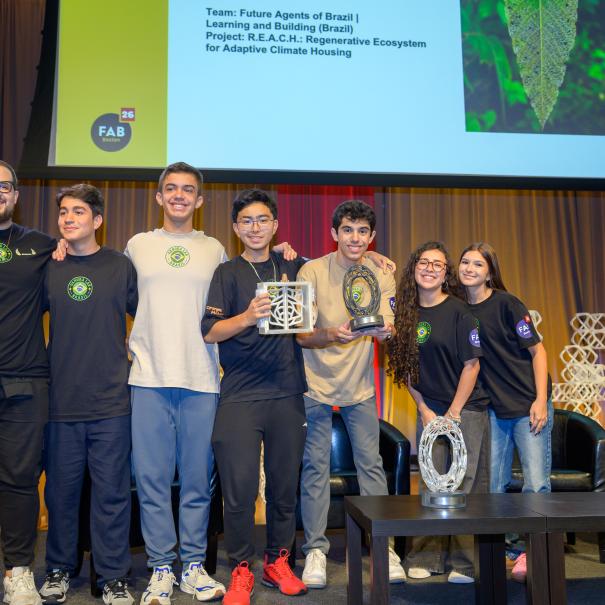
R.E.A.C.H.
Team: Luana Fernandes Casusa, Guilherme Kronka Mülfarth, Luca Cancela Camargo, Théo Alves Paliari, Pietra Arcanjo Ramos, Leonardo Jun Watanabe. Mentored by Miguel da Hora.
Location: Osasco, São Paulo, Brazil
In neighborhoods like Jardim Conceição in Osasco, Brazil, buildings are packed close together and there are few plants. Dangerous heat gets trapped indoors, and many families can’t afford air conditioning. This team, R.E.A.C.H., designed a three-part climate-adaptation kit built mostly from recycled PET plastic. Local waste-pickers helped design the block and the production chain.
The kit has three parts. FolhaFria is a 3D-printed cooling cobogó, a traditional Brazilian block with holes in it. Channels inside the block are modeled on plant veins and are designed to carry water that pulls heat out of a room. Yrapé is a rainwater collection and filter unit that feeds the system. Obá is a live climate-monitoring station that tracks temperature, humidity, and rainfall, with a dashboard and alerts for heat risk.
Waste-To-Solar Lantern
Team: Emmanuel Chima Ikwuegbu, Judith Felix, Golden Marcus, Goodness Promise. Mentored by Ebenezer Anyadiegwu.
Location: Aba, Nigeria
The team’s solar lantern, built in Aba, Nigeria, helps households, students, and market traders who deal with unreliable electricity. The casing is 3D-printed from recycled plastic filament, and broken lanterns are repaired instead of thrown away. A redesigned circuit board adds battery protection and charging indicator lights, and the lantern can be charged by solar panel, wall socket, or power bank.
During night visits in the Oberete-Asa community, the team found that an estimated 70–90% of market traders had poor lighting or none at all. So far, the team has made more than 200 lanterns, served more than 200 households, and trained more than 300 students and young people.
ReefTide
Team: Tomas Bernales-Jabur, Theodore Thompson, Vincent Wei, Charles Monier, Ireh Lin, Veer Belani, Willa Meyerse. Mentored by Noa Jaffe
Location: New York City, USA
ReefTide, a project from students at the Rudolf Steiner School in New York City, is a horizontal-axis tidal turbine designed to make clean electricity and give oysters a place to grow. It is built for the fast currents of the East Channel near Roosevelt Island. Two diffusers speed up the water flowing into the turbine. The team 3D-printed the tube and diffusers in about 30 pieces and joined them with epoxy. At the suggestion of community members, they added a live GoPro feed to the design.
The team tested it in the towing tank at Stevens Institute of Technology’s Davidson Laboratory and have signed Letters of Understanding with the Billion Oyster Project, the Roosevelt Island Operating Corporation, and the Roosevelt Island Residents Association.
Selected Projects
These finalists were part of the eight projects selected for the final round.
Anti-Flood Sewer Filter
Team: Letícia Faria, Maria Mariana Alves, Lara Gelenske, Germana Guimarães. Mentored by Martha Santos
Location: Recife, Brazil
Clogged storm drains cause repeated flooding in Recife, Brazil. This team built a filter from recycled plastic that sits inside the drain and traps debris. A sensor reports in real time how full the filter is, so crews can clear it before the rain arrives.
The team tested a small prototype in a real drainage grate near their partner lab. The final version is planned to run on solar power, and the team plans to share the design as open source so other cities can build their own.
Climate1
Team: Bhavika Kalia, Chahat Kalia, Anarghya Rajbanshi, Nalia Funk, Sage Milbury. Mentored by Jason Behrens
Location: Somerville, Massachusetts, USA
Instead of building a device, this team from Somerville, Massachusetts, is building a movement. Climate1 is a student-led platform where students anywhere can start a chapter, share projects, and request microgrants to turn their ideas into real climate solutions. Chapters are already active in La Paz, Bolivia, where students are tackling mercury pollution in rivers, and in Stow, Massachusetts, where a microgrant paid for science activity kits. Student groups in Punjab, India, and Burlington, Massachusetts, have also expressed interest.
Floating Regeneration Pod
Team: Tarini Patki, Ved Hariharan, Vir Hariharan, Aanya Shah. Mentored by Arbaz Reza
Location: Mumbai, India
Over half of India’s freshwater bodies are badly polluted, and most fixes are costly or chemical-heavy. This team from Mumbai built the Floating Regeneration Pod, a five hexagon-shaped pods that link together and float on a pond under one shared solar panel. Together, they filter out solids, convert toxic ammonia into safer compounds, trap microplastics, and remove heavy metals, all without chemicals or grid power. The prototype is now being field-tested with a local water conservation NGO.
From Plastic Waste to Purpose (PetCycle3D)
Team: Miguel Ángel Baena, Mathius Ibarbo, and Samuel Alejandro Molina, Johan Adrian Restrepo, Nicolas Montoya. Mentored by Ramiro Antonio Lopera, Juan Camilo Zapata, and Ivan Cortes.
Location: Medellín, Colombia
PetCycle3D is a low-cost machine that turns used PET bottles into 3D printing filament, so recycling can reach rural areas where hauling plastic away isn’t practical. The team used the filament to print rulers and protractors, which they shared with students, teachers, and community members in rural Antioquia, Colombia, including Jericó and Santa Rosa de Osos, and used their feedback to improve the design. Their goal is an open design that other communities can copy.
What next?
While the challenge has concluded, many teams have continued to work on their projects. The challenge showed what young people can do when they’re equipped with the tools, mentorship, and trust to tackle real problems. From a stream-healing station in Medellín to a tidal turbine built for oysters in New York, each team worked with its own community to build solutions that are both relevant and sustainable. The challenge may be over, but the work these learners started, and the change they are creating is only beginning.
Be the first to hear about the 2027 challenges.
Photo Credit: Stanley Rowin