A summer at MIT, where failing productively is part of the plan
By Mariah Rawding
November 2026
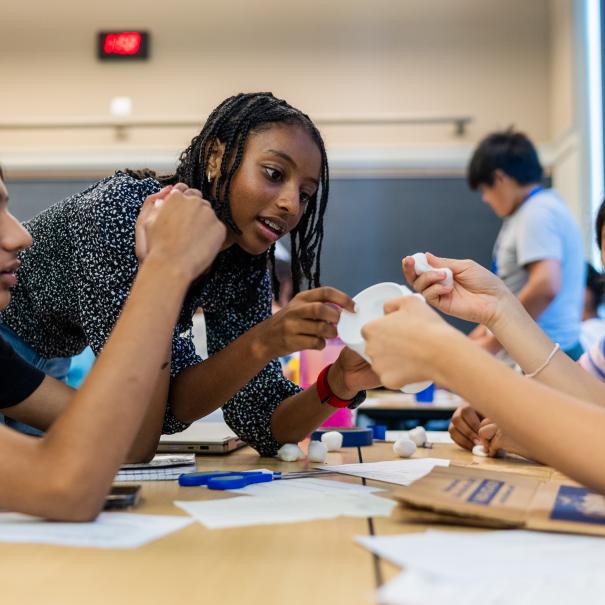
In July, more than 100 middle schoolers from across Massachusetts came to MIT ready to take part in Full STEAM Ahead, a program developed by the pK-12 Initiative at MIT. These learners spent three weeks on MIT's campus embarking on hands-on, project-based STEAM learning where they built and coded robots, designed sustainable fashion, told stories through maps, learned about food production, and more.
A different kind of classroom
What happens when there is more than one correct answer to a question? Or more than one way to solve the problem? STEAM learning encourages learners to combine what they know across multiple subjects to build an impactful solution.
This year's program leaned further into that philosophy by integrating a stronger technology and computational thinking focus throughout the curriculum. Over four modules, the middle schoolers took part in activities connected to the UN Sustainable Development Goals around Sustainable Cities and Communities and Climate Action. These were developed in collaboration with another pK-12 Initiative effort, Day of Climate. The team also worked with the XRP Robotics platform from Experiential, in collaboration with MIT Admissions, to give students hands-on experience with open-source robotics with an activity inspired by MIT’s Design and Manufacturing classes. These activities included:
Re-Inventing Fashion for the Future
by Liza Goldstein with contributions from Harley Carroll and Naya Nyamweya
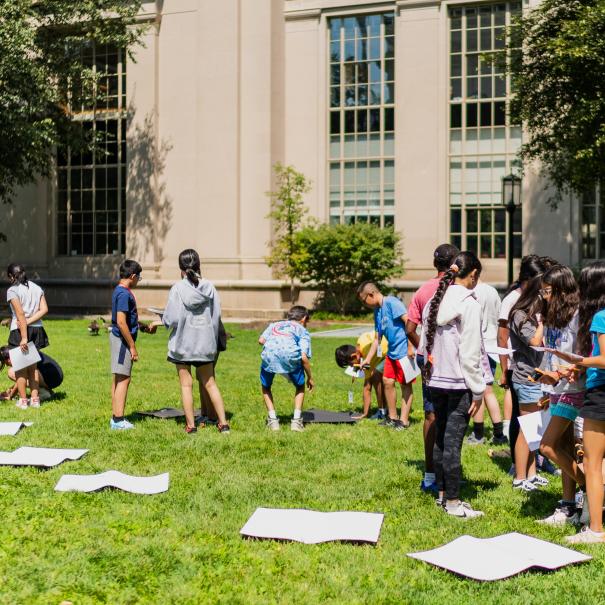
Participants created an eco-friendly textile using natural dyes and used upcycled materials to sew garments.
Data Storytelling for Climate Action
by Asenette Ruiz with contributions from Danube Shudic and Vivian Guerette
Investigating climate and environmental justice issues through data storytelling, geospatial analysis, and lived experience, participants communicated what the data means for people and places impacted by climate challenges.
Seeding Discovery: Designing Growing Space for Your Community
by Aleks Banas and Zachary Rapaport with contributions from Sabrina Su and Saloni Jain
Learners investigated global food systems and local community needs through MIT Farm case studies, equipping them to develop proposals for agricultural spaces. They considered their communities and immediate surroundings to develop ideas for their schools and neighborhoods.
Exploration with XRP Robotics
by Lauren Kenol, Shreya Goel, and Ezra Ko
Using the XRP robotics platform, students programmed small robots to navigate a series of movement challenges while learning more about coding and computational thinking.

Uncovering the secrets of STEAM
In the Secret Messaging Society, one of this year’s most popular activities, learners used cryptography to blend math, problem-solving, and history. Through inquiry-based, game-based, and project-based learning, learners discovered how mathematics is the hidden engine behind secure communication.
“The students were on a quest to understand how Bluetooth sends signals, how our WhatsApp messages are secured, and along the way, they learned mathematics,” says Shreya Goel, a recent graduate of the Harvard Graduate School of Education and the designer of the Secret Messaging Society.
“That's the beauty of introducing concepts through the world around you. Math isn't just about numbers, it's about the way the world works. It was an absolute delight to witness the faces of the students as they discovered that world for themselves.”
Working alongside pK-12 staff, Goel joined MIT student mentors, program assistants from local high schools, and a recent MIT MBA graduate to adapt the module content for a middle school audience. Learners spent their first two weeks rotating through four hands-on modules, then used the third week to turn a topic of their own choosing into an independent project, a structure that mirrors the design-thinking process used in courses common in high school and college.
Building toward something bigger
At Full STEAM Ahead, learners are encouraged to combine technical skill with creativity, collaboration, and communication — skills that are increasingly critical for all of us in the age of AI. All of these, combined with the ability to make mistakes, sets the program apart.
“One of the best opportunities we can give to the participants in our program is an environment to fail and try again. Thinking about issues they might face in their own lives, we challenge those who take part to create solutions based on what they’ve learned that might help them, their families, or others they care about,” says Joe Diaz, program manager and STEAM educator at the pK-12 Initiative, who has led the program's activities since 2020.
Celine Christory, MIT Sloan MBA ‘27 and summer coordinator for the program, adds, “By the end of the program, those who had arrived unsure of themselves were presenting their work with confidence, cheering on their teams, and asking questions that stumped their mentors. For me, that was the clearest proof of what this program can do for learners.”
Learn more about Full STEAM Ahead and the pK-12 Initiative, and find out how you can support the next cohort of student builders.